
Punjab News:Bhagwant Mann Govt Distributes Over 2.19 Lakh Property Cards Across 1,377 Villages Under ‘Mera Ghar Mere Naam’: Hardeep Singh Mundian
Punjab News:Bhagwant Mann Govt Distributes Over 2.19 Lakh Property Cards Across 1,377 Villages Under ‘Mera Ghar Mere Naam’: Hardeep Singh Mundian
*Scheme To Provide Legal Ownership Proof To Families Living In Lal Lakir Areas And Facilitate Bank Loans & Property Registration: Hardeep Singh Mundian*
*Bhagwant Mann Govt Committed To Providing Legal Ownership Rights To Residents Of Abadi Deh Areas Across All 10,689 Villages: Hardeep Singh Mundian*
*Scheme To Particularly Benefit Poor & SC Families, Enable Bank Loans & Minimise Property Disputes: Hardeep Singh Mundian*
*Online Portal For Correction Of Errors In Property Cards To Be Launched Shortly: Hardeep Singh Mundian*
*10,689 Villages Of Punjab Being Covered In 4 Phases; First Phase Likely To Be Completed By November 15: Hardeep Singh Mundian*
The Punjab Government led by Chief Minister Bhagwant Singh Mann is accelerating the implementation of its ambitious ‘Mera Ghar Mere Naam’ (MGMN) scheme, with over 2.19 lakh Property Cards distributed among beneficiaries in 1,377 villages across all 23 districts of the state as of November 2, 2026. The initiative aims to provide legally recognised ownership rights to residents of Lal Lakir (Abadi Deh) areas through drone-based surveys and preparation of an authentic Record of Rights, addressing decades-old gaps in property ownership documentation.
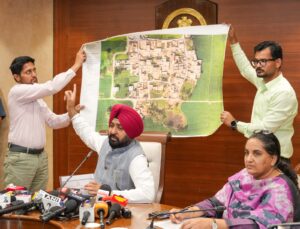
Addressing a press conference at Punjab Bhawan, Punjab Revenue, Rehabilitation and Disaster Management Minister Hardeep Singh Mundian said, “The scheme aims to establish clear ownership rights over properties situated within the Lal Lakir or Abadi Deh areas of all 10,689 villages of Punjab through drone-based surveys and preparation of an authentic Record of Rights. Property Cards are being issued to rightful owners to provide them with legally recognised documentary evidence of ownership.”
The Rehabilitation Minister said, “The distribution of Property Cards commenced with a state-level function held at Sangrur on October 7, 2026, and the process has since been progressing uninterruptedly on a daily basis.”
Elaborating on the implementation schedule, he said, “All villages are being covered in four phases. The work in 2,284 villages under the first phase is expected to be completed by November 15, 2026. Similarly, the second phase covering 1,680 villages is targeted for completion by the end of November, while the third phase involving 1,152 villages is expected to be completed by mid-December. The remaining 5,579 villages under the fourth phase are likely to be covered by January 2027.”
The Revenue Minister said, “The government is simultaneously working to complete missing information and resolve objections concerning village maps in coordination with village-level committees and Gram Sabhas. This exercise is aimed at ensuring accuracy and completeness of the revenue records.”
Minister Hardeep Singh Mundian further said, “In villages where drone surveys could not be conducted due to technical constraints, the process will be completed through ground truthing as the final stage of the department’s exercise.”
Highlighting the far-reaching benefits of the initiative, he said, “The rights of village residents had remained undocumented for decades despite their families occupying their houses for generations. The scheme is now addressing this long-standing gap by providing an official ownership document to every eligible household.”
“For years, residents of village Abadi Deh areas had no authentic government record to establish ownership of their houses despite living there for 30 to 40 years. This initiative will provide families with permanent documentary proof of ownership and help minimise property-related disputes and unnecessary administrative hardships,” he said.
Minister Hardeep Singh Mundian said, “The scheme would particularly benefit economically weaker sections and Scheduled Caste families for whom a house in the Abadi Deh is often their only immovable asset. With their properties being formally recorded in their names, these families will have an official document to safeguard their ownership rights and make productive use of their assets.”
He further said, “Property Cards would enable owners to avail bank loans against their properties and facilitate property registration. The initiative will also provide Gram Panchayats with accurate village maps to improve planning and execution of development works while helping the administration maintain digitised and reliable village-level property records.”
Reiterating the government’s commitment to ensuring that the benefits reach every eligible household, the Minister said, “The distribution process will continue on a daily basis until all targeted villages are covered.”
Clarifying the procedure for addressing discrepancies, Minister Hardeep Singh Mundian said, “Residents can approach their respective Halqa Patwari or Tehsildar to register objections in case of any clerical error or discrepancy in their Property Cards.”
He announced, “An online portal for submitting correction requests is also being launched shortly to enable people to apply for rectification from the comfort of their homes.”
Urging residents to collect their Property Cards and carefully verify the particulars recorded therein, Minister Hardeep Singh Mundian said, “People should ensure that any discrepancy is identified and rectified in time so that they can fully benefit from the ‘Mera Ghar Mere Naam’ scheme.”
*Bhagwant Mann Govt Is Providing Legal Ownership Rights To Residents Of Punjab’s Lal Lakir Areas Under Mera Ghar Mere Naam’*
The Punjab Government’s ambitious ‘Mera Ghar Mere Naam’ scheme is providing legal ownership documentation to residents of Lal Lakir (Abadi Deh) areas across the state, addressing a long-standing gap in village property records. Under the initiative, drone-based surveys are being conducted to prepare an authentic Record of Rights for houses and plots in the inhabited areas of Punjab’s villages, with Property Cards being issued to rightful owners as documentary evidence of ownership.
*Background And Objectives Of The Scheme:*
The inhabited areas of Punjab’s villages, known as Lal Lakir or Abadi Deh, remained outside formal revenue surveys and records for decades. Consequently, families living in their houses for 30 to 40 years often had no official map or government document establishing ownership or property boundaries. This created difficulties in proving ownership, led to prolonged disputes between neighbours and within families, and prevented owners from using their houses as security for bank loans. The absence of accurate maps also affected the planning of village development works.
Under ‘Mera Ghar Mere Naam’, the Punjab Government is preparing a Record of Rights for every house and plot in the Abadi Deh and issuing Property Cards to the respective owners. The scheme is particularly significant for poor and Scheduled Caste families who do not own land outside the Abadi Deh, as their house is often their only immovable asset.
*Scheme And Legal Framework:*
In December 2025, the Punjab Cabinet led by CM Bhagwant Singh Mann amended the Act to reduce the time for filing and deciding objections and appeals to 30 days, against the earlier timelines of 90 and 60 days.
*How The Record Of Rights Is Prepared:*
The process begins with the government notifying the Abadi Deh area to be recorded, followed by informing the village through Munadi under Section 5 of the Act.
The ARRO subsequently constitutes a Village Level Committee under Section 8. The Survey of India then conducts a drone survey of the Abadi Deh and prepares maps of individual houses and plots under Section 6.
The Patwari or Survey Officer, along with the Village Level Committee, visits each house to identify and record its owner through Map-1 under Section 9.
Thereafter, the draft map and list of owners are displayed in the village and supplied to the Gram Panchayat. Property details are also sent to owners through WhatsApp so that they can verify the information and seek corrections before finalisation. This exercise is undertaken through Map-2 under Section 10.
Objections can be filed before the ARRO within the notified period and are decided after hearing the concerned parties under Section 11. Entries against which no objection is received become final.
The final map, known as Map-3, and the Record of Rights are attested by the Patwari, Kanungo and ARRO. One copy is deposited in the District Record Room, while another remains with the Patwari under Section 16. Property Cards are subsequently generated from the final Record of Rights and handed over to the owners.
*Distribution Of Property Cards And Latest Progress:*
Property Cards are being distributed through functions organised in individual villages so that owners do not have to visit government offices to collect them. Owners who cannot attend the distribution function receive their cards at home within two days in the presence of a Village Level Committee member.
Each owner receives a laminated Property Card in an envelope along with a letter from the Chief Minister. The card is available in Punjabi and English and contains the survey unit number, GPS location, drone map of the property and a QR code through which the details can be verified online.
Every handover is recorded by the Patwari in a register and updated daily on the Jamabandi Portal.
As of November 2, 2026, over 2.19 lakh Property Cards have been distributed among beneficiaries in 1,377 villages across all 23 districts of Punjab.
*Four-Phase Distribution Schedule:*
The distribution exercise is being undertaken across all 10,689 villages in four phases.
The first phase covers 2,284 villages and is targeted for completion by November 15, 2026. The second phase covers 1,680 villages and is expected to be completed by the end of November 2026. The third phase involves 1,152 villages, with completion expected by mid-December 2026.
The remaining 5,579 villages are covered under the fourth phase, which is likely to be completed by January 2027.
*Correction Of Errors And Online Appeal Facility:*
Property owners can seek correction if they find any discrepancy in their Property Cards, including errors in names, ownership shares or property area.
At present, an appeal along with supporting documents can be submitted at the office of the ARRO, namely the Tehsildar or Naib Tehsildar.
From December 2026, owners will also be able to submit correction requests online by scanning the QR code on their Property Cards and uploading the necessary documents. The online facility is being developed so that residents will not have to visit government offices for rectification.
Appeals are decided under Chapter V of the Act. Owners who are not satisfied with the decision of the ARRO can approach the RRO (SDM) and subsequently the CRRO (Deputy Commissioner). If a correction is allowed, a revised Property Card is issued.
*Transparent And Verifiable Process:*
The scheme incorporates several measures to ensure transparency and enable owners to verify the information recorded against their properties.
Property owners are identified house by house during the survey in the presence of the Village Level Committee. Where information is missing, it is completed through the Gram Sabha.
Draft maps and lists of owners are publicly displayed in the village and supplied to the Gram Panchayat. Individual property details are also shared with owners through WhatsApp.
Objections are decided by the ARRO only after hearing the concerned parties, and orders can be challenged through the prescribed appellate mechanism.
Property Cards are handed over at public village-level functions. In cases of home delivery, the process takes place in the presence of a Village Level Committee member and against the owner’s signature.
Every handover is recorded in a register and updated on the Jamabandi Portal. Progress is monitored village by village at the district and state levels.
The final Record of Rights is duly attested and maintained in the District Record Room, with another copy available with the Patwari. The QR code on the Property Card enables online verification, including by banks.
*Benefits For Residents And Rural Development:*
The scheme provides several benefits, particularly to families whose houses in the Abadi Deh represent their only immovable property.
Poor and Scheduled Caste families without land outside the Abadi Deh will receive an official government record of their houses in their own names, providing documentary protection to their ownership rights.
The Property Ownership Certificate provides legally recognised evidence of ownership under the 2021 Act. It can also facilitate property registration and enable owners to offer their houses as security for bank loans for business, farming, education or healthcare.
The recording of ownership shares and demarcation of boundaries through drone-based maps is expected to help reduce property disputes. The record also remains in the owner’s name even if the family lives elsewhere or abroad.
For Gram Panchayats, accurate maps of houses, roads, drains and public spaces will facilitate better planning of village development works. The initiative will also provide the administration with digitised and reliable village-level maps and property records.
Through ‘Mera Ghar Mere Naam’, families who have lived in their houses for generations will, for the first time, receive an official government record of ownership in their own names.
———-